

Staff Shortages in Cinemas
More time for your guests through digitalisation in cinemas
Friday evening in the foyer. The auditorium is filling up, anticipation is palpable, conversations and laughter everywhere. Your team is right in the middle of it all, greeting guests, making recommendations, ensuring the evening begins the way it should end: with a smile.
That is cinema. These moments happen when your team can be where it matters most: close to the guest.
At the same time, a study by the cinema associations in cooperation with GfK shows: 88 percent of cinemas are looking for staff, 62 percent struggle to fill open positions, and 82 percent name service and concession stands as their biggest challenge. These are not abstract numbers. This is the everyday reality we all know.
The good news: there are ways to deal with it. Ways that relieve the burden on your team while enhancing the experience for your guests.
Of course, there are multiple approaches to addressing staff shortages in cinemas. Nurturing new talent, offering mentoring, enabling further training, strengthening networks.
In a study by the cinema associations in cooperation with GfK, for example, it becomes clear how much employee retention, reliable scheduling, and continuing education shape everyday work life.
And at the same time, there is another perspective that can counteract staff shortages: digitalisation in cinemas.
What to expect:
Where staff shortages in cinemas become noticeable
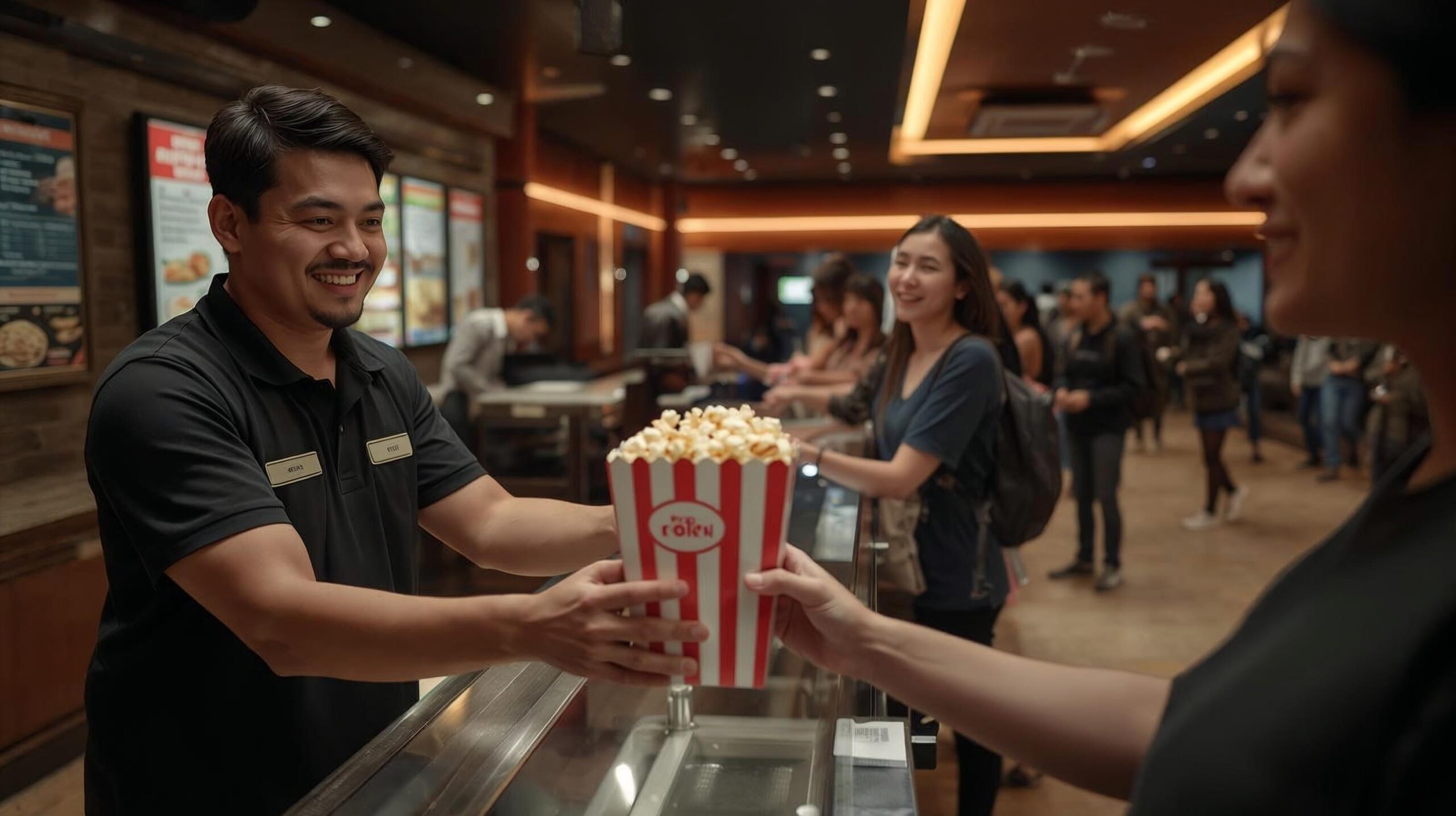
Cinema staff are rarely assigned to just one role. Cinema employees are all-rounders. They work at the box office, prepare popcorn, check tickets at the entrance, and step in wherever they are needed.
This is exactly what makes staff shortages in cinemas so noticeable. When hands are missing, they are missing everywhere at once. It is most apparent in direct guest contact: the queue at the concession stand grows longer, waiting times increase, and the evening begins with stress instead of anticipation.
At the same time, the pressure shifts to the remaining employees. The GfK study describes exactly this: increased workload, overtime, and the challenge of maintaining consistent quality.
Staff shortages in cinemas also affect administration and technical operations. Employees who should be there for the guests end up handling repairs or administrative tasks. The question is: which of these tasks can be solved differently?
- 88% of cinemas are looking for staff
- 62% struggle to fill vacancies
- 82% name service and concessions as their biggest challenge
- Pressure is shifted onto the remaining employees
- Technology and administration tie up additional capacity
What digitalisation in cinemas can change
Digitalisierung im Kino ist kein Ersatz für Menschen. Sie ist eine Möglichkeit, Routineaufgaben so zu gestalten, dass dein Team sich auf das konzentrieren kann, was wirklich zählt: die Erlebniswelt für deine Gäste.
igitalisation in cinemas is not a replacement for people. It is a way of designing routine tasks so that your team can focus on what really matters: the world of experience for your guests.
The idea behind it is simple: not every interaction requires the same level of attention. Some tasks are transactions. The guest knows what they want and wants to get it quickly. Other moments are encounters: a recommendation, a short exchange, a friendly look.
If the transaction is already completed before the guest even enters the foyer, there is more room for genuine interaction. That is not a contradiction to hospitality. It is a prerequisite for it.
- Digitalisation does not replace people, it supports them
- Transaction and interaction are two different moments
- Solving routine tasks digitally creates room for genuine hospitality
Options in direct contact with guests
Online concessions in cinemas
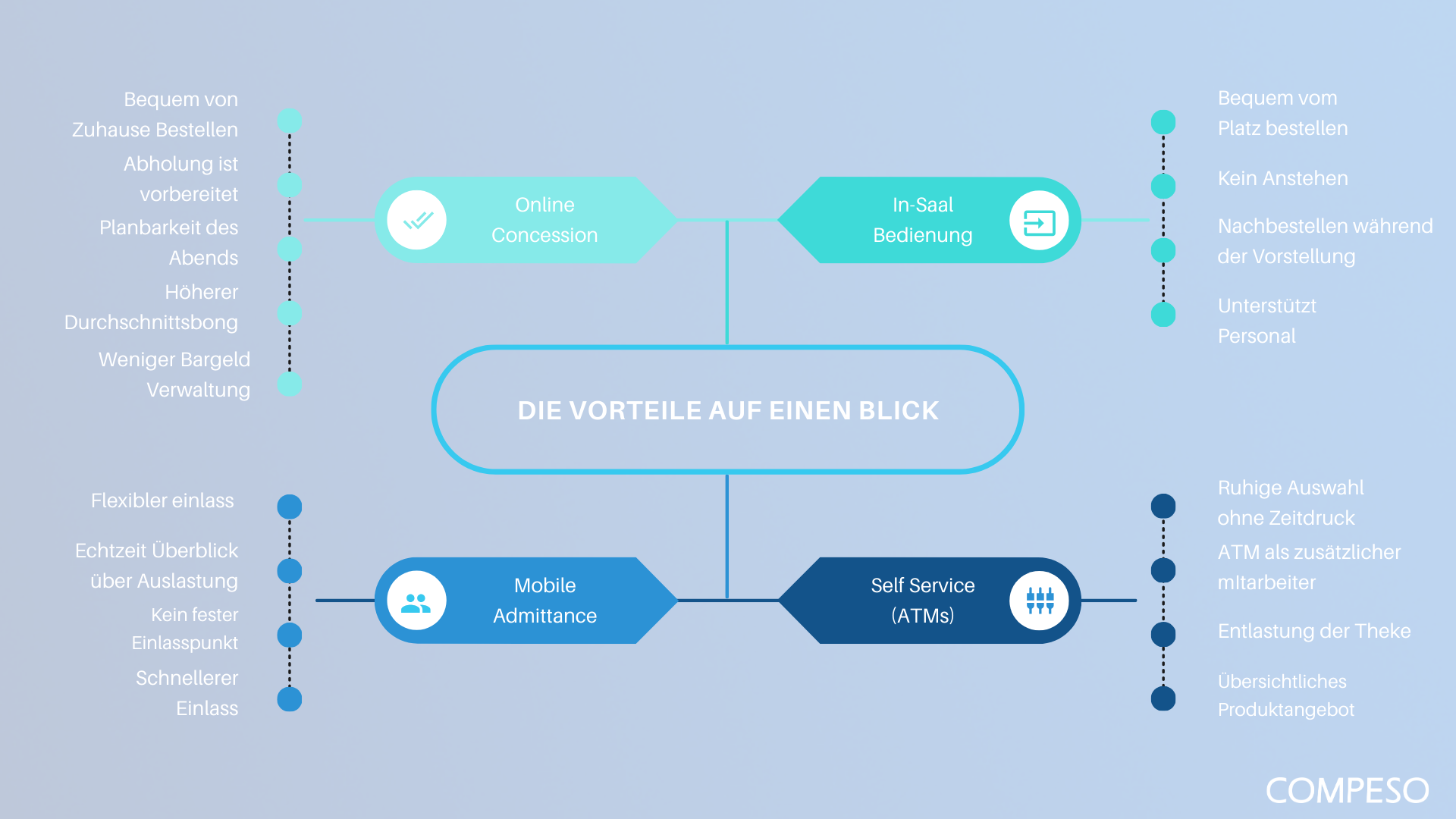
Online concessions allow guests to place their order before they even visit the cinema. The advantage: once they arrive in the foyer, everything is already prepared. No queueing, no waiting time, just a smooth start to the evening.
For your team, this means better planning. You know earlier how much needs to be prepared. Peak periods in the evening become more predictable. And your employees have more time to take care of guests who come spontaneously or are looking for a recommendation.
Anyone who orders online also pays online. That means less cash at the counter, less change to handle and less counting at the end of the evening. Time that would otherwise go into cash reconciliation is now available for other tasks.
- Guests order conveniently from home
- Tickets and concessions in one place on their phone
- Collection at the cinema is already prepared
- Better planning: you know earlier what needs to be prepared
- Higher average basket value through relaxed browsing in the webshop
- Less cash at the counter
- No change, no counting at the end of the evening

Self-service in cinemas
elf-service works in a similar way, only directly on site. Terminals in the foyer allow guests to place their own orders. The same applies here: guests who know what they want get it quickly. And your team can be where it is needed most.
For guests, this means they can browse the range in peace without a queue behind them. Choices become more deliberate, and extras such as larger portions or toppings are noticed more often. For you, the terminal is like an additional employee at the counter who never calls in sick, needs no training and works reliably even during peak times.
- Relaxed browsing without time pressure
- Fast processing for guests who know what they want
- The terminal as an additional employee during peak times
- Less pressure on the counter, more capacity for advice
In-Seat service in cinemas
A third approach goes one step further: ordering directly from the seat. The guest scans a QR code, orders via smartphone and has everything delivered to their seat. No getting up, no trip to the counter, no missing the trailers.
For your team, this means orders come in digitally, preparation runs in the background and delivery is carried out in a targeted way. Especially during longer films or events, this can increase revenue because guests can reorder during the screening.
- Guests order conveniently from their seat
- No queueing, no missing scenes from the film
- Repeat orders during the screening are possible
- Additional revenue without additional workload at the counter
- Delivery is targeted and quiet
- Another way to support employees
In-Seat service at Gloria Palast
Mobile Admittance
The classic admissions process: show the ticket, tear it off or scan it, then move on. With Mobile Admittance, this becomes more flexible. Your team scans tickets using a mobile device, whether at the entrance, in the foyer or directly in front of the auditorium.
This creates clarity. You can see in real time how many guests have already arrived, which screenings are well attended and where there is still capacity. And your team is no longer tied to one fixed point, but can be wherever it is needed.
- Flexible admissions at different points
- Real-time overview of occupancy
- Team stays mobile and can react flexibly
- No fixed admissions point required
- Faster admissions during peak times
What these solutions have in common
Online concessions, self-service and in-auditorium ordering all pursue the same goal: separating the moment of transaction from the moment of interaction.
The guest decides for themselves when and how they order. Payment is completed before your team comes into play. What remains is preparation and handover. No cashing up, no change, no pressure.
These approaches can be combined depending on what suits your cinema best. Online concessions for planners, self-service for spontaneous guests, in-auditorium ordering for those who like convenience.
- All three solutions separate transaction and interaction
- Your team shifts from processing to hosting
- The approaches can be used individually or in combination
Processes in the background
Planning through guest data in cinemas
Digitalisation in cinemas brings another advantage: data. When guests book online, order via terminals or place repeat orders in the auditorium, valuable information is created. Which products perform well? When are peak times? Which screenings generate the highest concessions revenue?
This guest data helps you plan more effectively. You can deploy staff more precisely, calculate stock orders more accurately and manage campaigns based on data. Instead of deciding by gut feeling, you have a solid foundation.
And if guests use a customer account, even more becomes possible: personalised offers, reminders about favourite films and birthday campaigns. Marketing that runs automatically while still feeling personal.
- Digital processes automatically generate valuable data
- Better planning of staff and stock levels
- Targeted campaigns instead of gut feeling
- Customer accounts enable personalised marketing
- Automation saves time but still feels personal
Automated communication
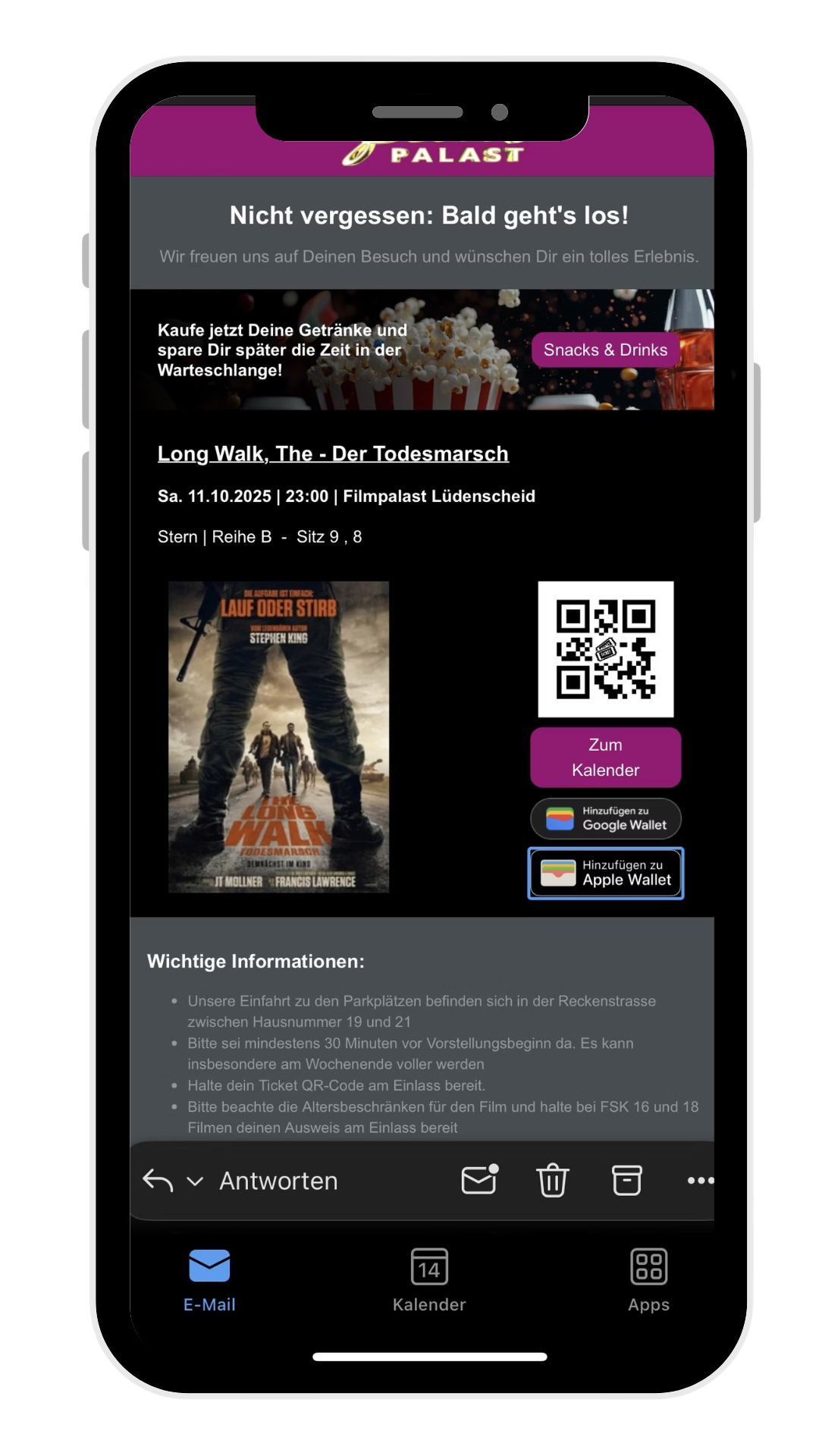
Every booking triggers a chain of communication: confirmation email, reminder before the cinema visit, directions, information about concessions collection. With automated communication, all of this runs in the background. The guest receives the right information at the right time. Where can I find the cinema? Where do I collect my order? What can I expect this evening? This reduces queries at the box office and ensures that guests arrive well prepared.
For your team, this means less explaining, less phone time and less repetition. Communication runs without anyone having to think about it.
- Booking confirmations and reminders run automatically
- Guests know in advance where they need to go
- Fewer questions at the box office and on the phone
- Information about concessions collection saves time in the foyer
- Automatic concessions reminders can increase revenue
- Once set up, it runs without extra effort
Digital signage
A schedule change at 2 pm, a new film from Thursday, a special promotion at the weekend. Anyone still managing this with posters and notices knows what it means: printing, putting them up, taking them down and disposing of them all takes time.
With digital signage, information updates automatically. Screens in the foyer show the current schedule, prices and promotions. Changes are entered centrally and become visible immediately. No walking around, no paper, no outdated notices.
For your team, that means one click instead of one hour. And guests are always up to date.
Schedule and information update automatically
Changes are visible immediately
No printing, hanging up or disposal
Less manual work, more time for guests
Professional appearance in the foyer
The first step
Digitalisation in cinemas does not have to be a major project. It often starts with a single process that makes the biggest difference in everyday operations.
One possible starting point: activate online concessions in your cinema and let guests collect them at the main counter to begin with. That makes it easy to get started, and later you can offer a separate collection counter. The effect becomes visible quickly. Guests who have pre-ordered arrive relaxed. The counter is relieved. Your team has more room for the guests who decide spontaneously.
The key is this: start small, stabilise one process and then expand. And involve your team from the very beginning.
- No major project needed, start with one process
- Link online concessions to a clear collection process
- Stabilise first, then expand
- Involve the team from the start
Mastering staff shortages in cinemas: more time for your guests
Staff shortages in cinemas are a reality that many cinema operators are dealing with. The challenge is real. At the same time, there are approaches that work in everyday operations.
Digitalisation in cinemas can take over routine tasks. Self-service in cinemas and online concessions in cinemas make processes more predictable and reduce pressure on your team. The effect: more room for what cinema is really about. More time for your guests.
Your guests want an experience. Your team can deliver it, if the right conditions are in place.

Edin Demirezen
With aproximately 20 years of cinema experience and as the long-standing theatre manager of Cineplex Alsdorf (Stürtz family), Edin knows everyday cinema operations from first-hand experience.
Today, he brings his expertise to Compeso as a consultant for cinemas and for our development team, helping cinema teams receive the support that truly moves them forward in everyday operations.
Cinema has been part of his life for many years, and that passion is reflected in the way he supports cinemas.
